Why early mathematics matters and how educators and professional organizations can help every child get off to a strong start.
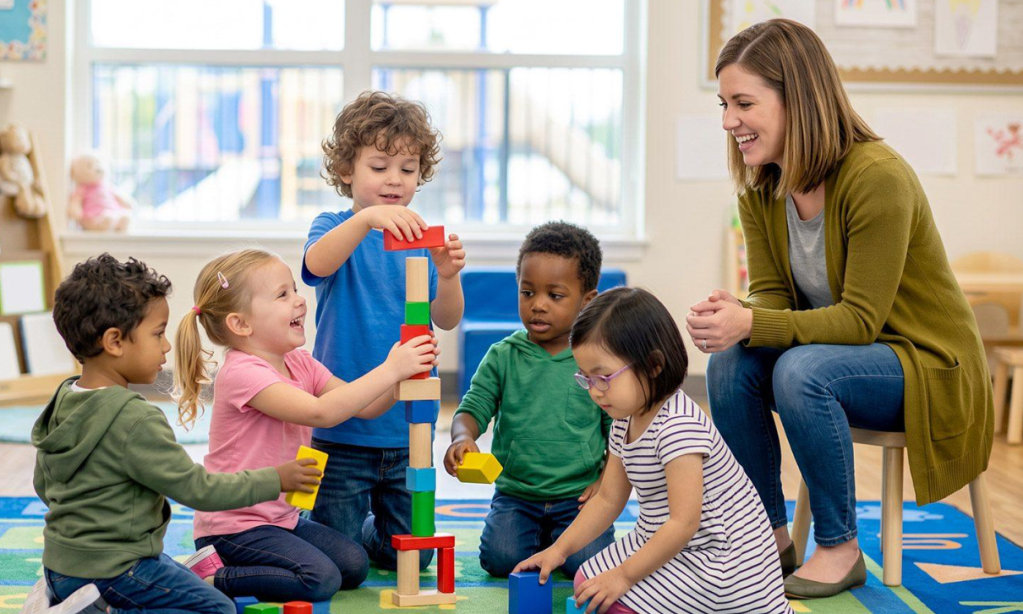
Young children building blocks and exploring mathematical ideas.
What if Math Success Starts Before Kindergarten?
What if some of our biggest mathematics challenges begin before children ever take their first standardized math test? Young children already explore mathematical ideas when they count toys, compare object sizes, build with blocks, recognize patterns, and figure out how to share materials with classmates. These everyday experiences may seem simple, but they help children develop the foundation for future mathematical learning.
The important question is whether adults recognize and intentionally support these opportunities. Early childhood mathematics is more than memorizing numbers or completing worksheets. It involves helping children explore, ask questions, solve problems, and explain their thinking. Professional organizations play an important role in ensuring educators have the knowledge, resources, and support they need to provide these experiences. Two organizations working together toward this goal are the National Association for the Education of Young Children (NAEYC) and the National Council of Teachers of Mathematics (NCTM).
Why Early Math Matters
Children encounter mathematics long before they enter a formal mathematics classroom. A child who sorts toys by color is exploring classification. A child who builds a tower is learning about shapes, balance, and spatial relationships. When children compare which container holds more water or decide how to divide snacks among friends, they are exploring measurement, quantity, and problem-solving.
These experiences matter because young children learn by actively engaging with the world around them. Turrou et al. (2021) explain how educators can build on children’s mathematical thinking through playful, intentional teaching. Rather than treating mathematics as a separate activity that only happens during a scheduled lesson, teachers can connect mathematical ideas to play, classroom routines, conversations, and children’s interests.
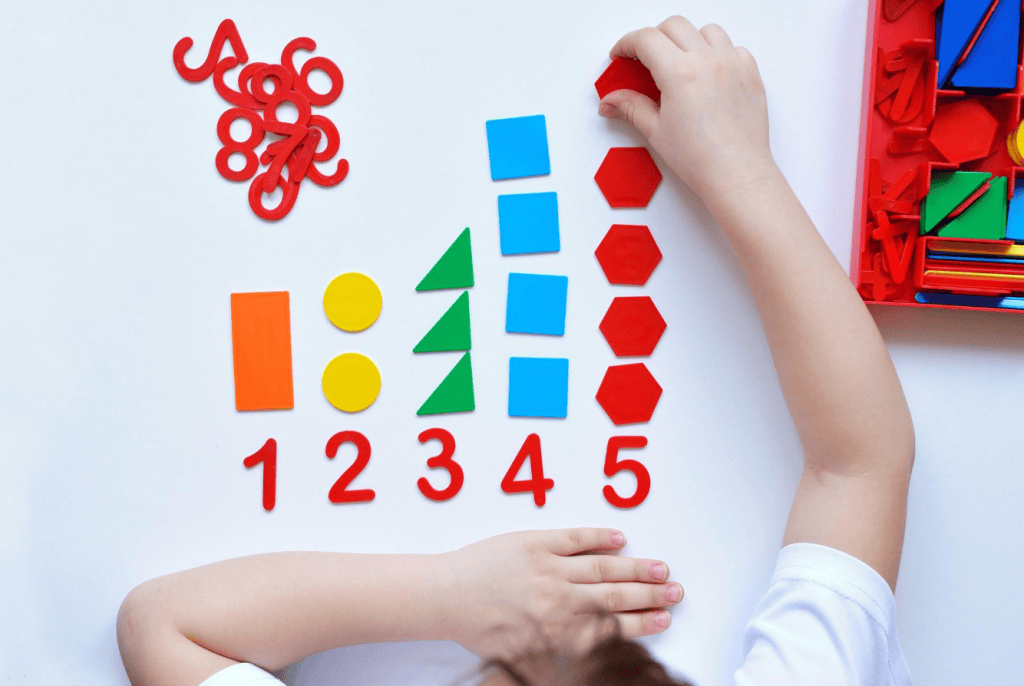
A young child sorts geometric shapes while exploring early mathematics.
For example, a teacher might ask children to predict how many blocks they need to build a tower taller than another. Instead of immediately providing the answer, the teacher can encourage children to count, compare, test their ideas, and explain what they notice. These interactions make mathematics meaningful and help children build confidence in their thinking.
NAEYC and NCTM: Advocating Together
NAEYC focuses on high-quality early childhood education, while NCTM promotes effective mathematics teaching and learning. Their partnership combines knowledge of young children’s development with expertise in mathematics education.
Their joint position statement, Early Childhood Mathematics: Promoting Good Beginnings, affirms that high-quality, challenging, and accessible mathematics education for children ages three to six provides an important foundation for future learning (National Association for the Education of Young Children [NAEYC] & National Council of Teachers of Mathematics [NCTM], 2010).
The statement emphasizes that young children need opportunities to explore mathematical concepts, develop problem-solving skills, communicate their thinking, and connect mathematics to other activities. It also recognizes that teachers need appropriate resources, preparation, and organizational support to provide these experiences.
This partnership is important because improving early mathematics education requires more than asking individual teachers to do better. Educators also need access to research-based teaching practices, professional learning, effective curriculum, and policies that support their work. By bringing their expertise together, NAEYC and NCTM help communicate why early mathematics deserves attention and investment.
Advocacy Is More Than Making a Statement
Advocacy involves identifying needs, sharing information, building partnerships, and working toward meaningful improvements. Professional organizations can help educators understand how decisions about curriculum, resources, professional development, and educational policy affect children.
Bond (2016) examined how professional organization workshops helped preservice teacher leaders learn about legislative advocacy. Participants developed a better understanding of the legislative process and ways to communicate their concerns to policymakers. This research highlights how professional organizations can help educators move beyond recognizing problems and begin taking action.
For early childhood mathematics, advocacy can include encouraging schools to provide teachers with mathematics-focused professional development, ensuring classrooms have appropriate materials, and helping decision-makers understand the importance of playful, intentional mathematics instruction. It can also involve sharing research with colleagues, communicating with school leaders, and supporting policies that give young children meaningful learning opportunities.
Educators do not need to hold leadership positions to become advocates. They can begin by observing children’s needs, reflecting on classroom practices, discussing concerns with colleagues, and connecting with professional organizations. These actions can help build a stronger foundation for larger changes.
The Challenge of Equity
One of the most important reasons to advocate for early mathematics is equity. Children do not all enter school with the same experiences, resources, or opportunities to explore mathematical ideas. Some have access to books, toys, educational programs, and adults who regularly engage them in mathematical conversations. Others may have fewer opportunities because of barriers related to resources, access, or educational support.
NAEYC’s (2019) position statement on advancing equity emphasizes that all children deserve equitable learning opportunities and that early childhood educators have a professional responsibility to advance equity. This principle connects directly to mathematics education. Every child should have opportunities to explore numbers, patterns, shapes, measurement, and problem-solving in ways that respect their abilities, backgrounds, languages, and experiences.
Equity does not mean that every child needs the exact same activity or support. It means educators recognize children’s individual strengths and needs and provide appropriate opportunities for participation and learning. For example, teachers can use visual materials, manipulatives, hands-on activities, and different ways for children to communicate their thinking.
NAEYC and NCTM’s joint position statement supports the importance of accessible mathematics experiences and emphasizes the need for resources and educational practices that help teachers meet children’s needs (NAEYC & NCTM, 2010). Advocacy helps keep these responsibilities visible as schools and communities make early learning decisions.
Supporting Teachers and Families
Although early mathematics is important, educators may not always feel confident teaching it. Some teachers may be more comfortable supporting literacy than mathematics, while others may need additional preparation to recognize the mathematical concepts embedded in children’s play. Without support, educators may overlook these opportunities.
Professional development can help teachers identify mathematical thinking, ask questions that encourage reasoning, and create activities that extend children’s learning. Administrators and educational leaders can support this work by providing time for collaboration, access to appropriate materials, and opportunities for teachers to learn from one another.

An early childhood educator supports children as they explore mathematics with hands-on materials.
Families and caregivers also play an important role. Mathematics does not have to start with formal lessons or worksheets at home. Everyday activities such as cooking, shopping, sorting laundry, setting the table, and playing games provide opportunities to count, compare, measure, and recognize patterns. Educators can help families recognize these moments and feel confident supporting learning in their own ways.
When schools share practical ideas with families and caregivers, they strengthen the connection between children’s experiences at home and in the classroom. This partnership helps make mathematics a familiar and meaningful part of children’s daily lives.
What Can We Learn From These Advocates?
NAEYC and NCTM demonstrate the value of bringing professionals together around a shared goal. Their joint work connects early childhood development, mathematics education, research, classroom practice, and policy. Their position statement also makes clear that effective mathematics education depends on both what teachers do and the support systems available to them.
Grace (2018) highlights the importance of responding to the call to advocate for young children and the early childhood profession. Advocacy requires more than agreeing that children deserve better opportunities. It involves communicating needs, building relationships, and encouraging change.
As educators, we can apply this message by learning about professional organizations, sharing research with colleagues, recognizing gaps in children’s learning opportunities, and speaking up when resources or support are needed. We can also listen to families and caregivers because their experiences offer valuable insight into what children need to succeed.
Starting With the Youngest Mathematicians
Mathematics advocacy should begin early because children’s mathematical understanding develops through their everyday experiences. When teachers recognize the mathematics in play, families encourage curiosity at home, and professional organizations advocate for quality instruction and adequate resources, children have more opportunities to develop strong mathematical foundations.
NAEYC and NCTM show how collaboration can help turn a shared belief into a call for action. Their work reminds us that supporting young mathematicians is not the responsibility of one teacher or one organization. It requires educators, families, school leaders, professional organizations, and policymakers to work together.
Every child deserves opportunities to explore mathematics, ask questions, make discoveries, and develop confidence as a learner. When we advocate for these experiences from the beginning, we help children build a foundation that can support their learning for years to come.
Math starts early, and so should our advocacy.
References
Bond, N. (2016). Preservice teacher leaders learn to advocate legislatively through professional organizations. Journal of Curriculum and Teaching, 5(2), 25–36. https://doi.org/10.5430/jct.v5n2p25
Grace, C. (2018). Answering the call. YC: Young Children, 73(3), 82–86.
National Association for the Education of Young Children. (2019). Advancing equity in early childhood education: A position statement. https://www.naeyc.org/resources/position-statements/equity
National Association for the Education of Young Children, & National Council of Teachers of Mathematics. (2010). Early childhood mathematics: Promoting good beginnings. https://www.naeyc.org/positionstatements/mathematics
Turrou, A. C., Johnson, N. C., & Franke, M. L. (2021). The young child and mathematics (3rd ed.). National Association for the Education of Young Children.


Leave a Reply